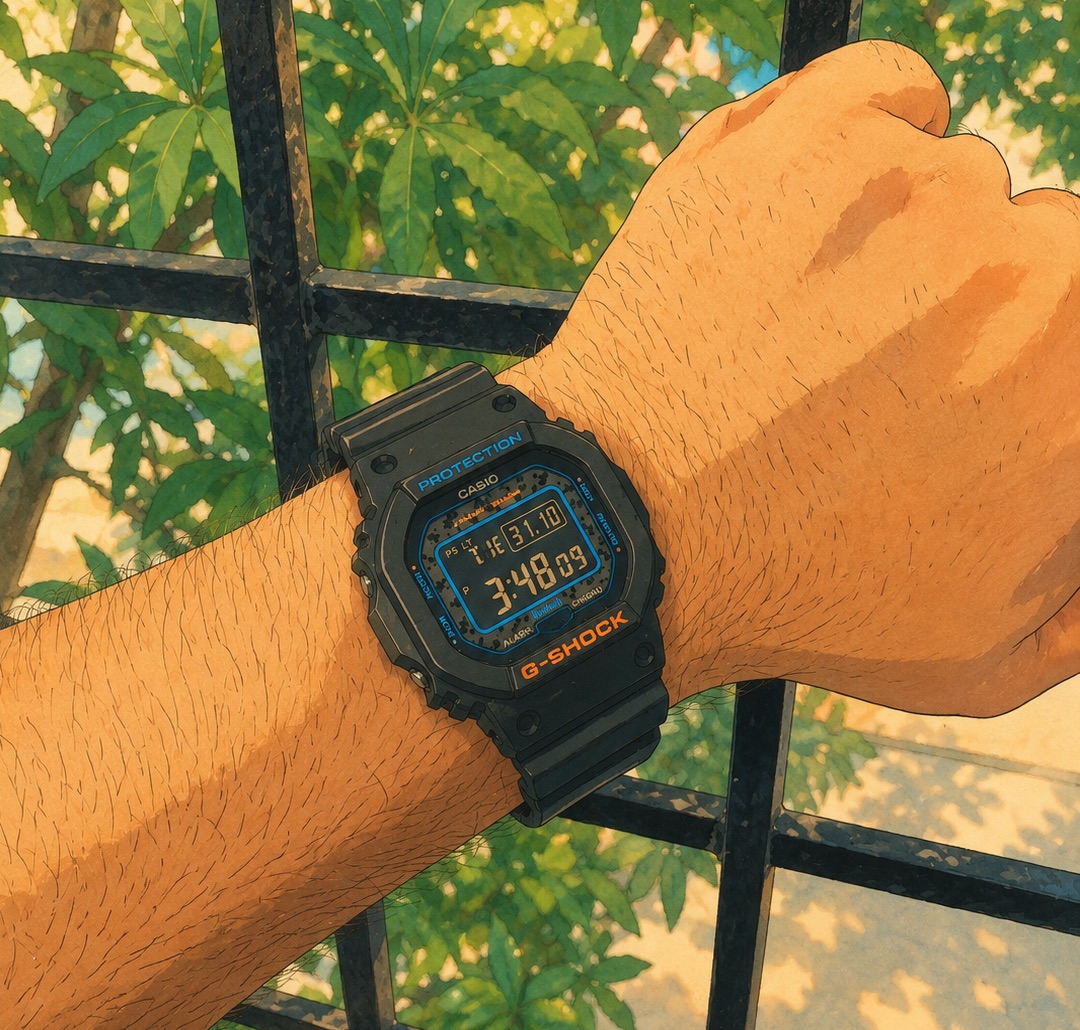
I spend most of my waking hours looking at screens. I write code on one, ship features through another, read on a third, and answer messages on a fourth that lives in my pocket. The last thing I want strapped to my wrist is a fifth.
That, in one sentence, is the longest version of why my daily watch is a CASIO G-Shock GW-B5600 and not an Apple Watch, a Galaxy Watch, or any of the other smartwatches that have quietly multiplied around me over the last few years.
This is not a hot take. I have nothing against smartwatches. Friends I trust wear them and love them, and they get real value from the health tracking and the on-wrist messaging. But for the way I actually live and work, the G-Shock turned out to be the right answer to a question I had not been asking carefully enough: what do I actually want from a wrist device?
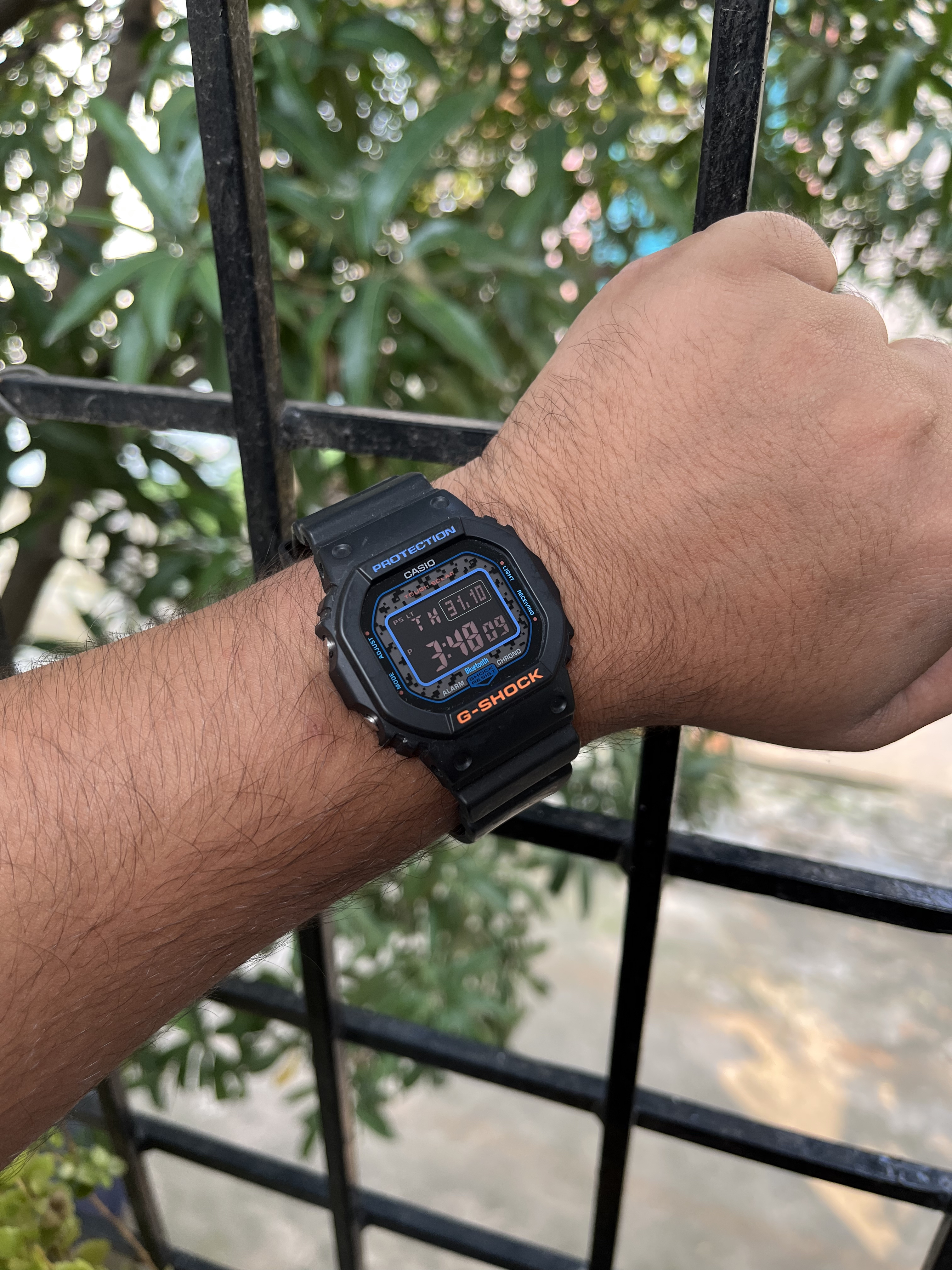 My GW-B5600 on a Bengaluru afternoon: Tough Solar cell ringing the display, Bluetooth time-sync indicator on the face, and a case shape that has not meaningfully changed since 1983.
What the GW-B5600 actually is
Before the philosophy, the spec sheet. The GW-B5600 is a square, resin-cased G-Shock from Casio’s “Origin” line, the direct descendant of the DW-5000C from 1983, which was the first G-Shock ever made. Same shape. Same restraint. Forty-plus years of iteration on the inside, very little change on the outside.
What lives inside the case today:
- Tough Solar. A thin solar cell rings the display; the watch charges itself off any light source. There is no charging cradle, no USB-C cable, no nightly habit. It charges while it is on my wrist.
- Multi-Band 6 radio. The watch listens for radio time signals from six transmitters around the world. At night it syncs itself to atomic time. I have not manually set the time on this watch since I bought it.
- Bluetooth Mobile Link. It pairs with the Casio Watches app for additional time-zone updates, world-time city changes, and a one-tap “find my phone” beep. That is the entire scope of its “smart” features, and that is exactly the right amount.
- 200m water resistance and the usual G-Shock shock structure. I do not have to take it off for anything I actually do.
- 48.9 × 42.8 × 13.4 mm, 53 grams. Small enough that I forget I am wearing it. Heavy enough to feel honest.
None of those features are exciting in isolation. The interesting thing is what they add up to: a wrist computer that has been ruthlessly optimised to disappear.
A battery I never think about
The first thing I noticed, after a few weeks of wearing it, was an absence. I had stopped having a category of thought in my head: is my watch charged?
Anyone who has worn a smartwatch knows that thought well. It is small, but it is there every day: a low hum of charge anxiety. Even on watches with “good” battery life, you are still on a 24 to 72-hour treadmill. You build a habit around the cradle. You forget the cradle one weekend trip and you arrive somewhere with a dead watch.
The GW-B5600 has no cradle. It has no battery, in the user-facing sense. There is a rechargeable cell inside, but you do not interact with it. You wear the watch in normal indoor light, walk past windows occasionally, and the cell stays full. Casio rates it for around ten months of operation in total darkness on a full charge. I have, functionally, never seen it below “high.”
This sounds like a minor convenience. It is not. It is the difference between owning a tool and maintaining a device. A tool is something you use; a device is something that asks things of you. After enough years of devices, the tool feels almost subversive.
Accuracy I never have to maintain
I have written code that handles timestamps, time zones, daylight saving transitions, and the strange little corners of timekeeping that bite you the moment you assume time is simple. Time on most consumer devices is set by NTP and stays accurate because the device phones home. Time on most analog and quartz watches drifts by a few seconds a month and you nudge it back when you notice.
The GW-B5600 sits in a different category. It has two ways to stay correct. The first is Multi-Band 6, which listens for long-wave atomic time broadcasts from six transmitters worldwide: two in Japan, and one each in the US, UK, Germany, and China. India is honestly out of range; the nearest transmitter (BPC in China) is around 4,000 km away, and the reliable reception envelope for these signals is closer to 2,000–3,000 km. If I travel to Tokyo or Munich, the watch will quietly correct itself overnight. In Bengaluru, the radio stays mostly idle.
The second mechanism is Bluetooth Mobile Link, and this is the one that actually matters for me in India. The Casio Watches app on my phone holds an accurate time, and when the watch is paired it syncs once a day automatically. It also nudges itself any time I open the app. This is the entire reason the “B” exists in GW-B5600. The older GW-M5610U is a radio-only watch, and outside the six coverage regions it is a manual-set watch. The Bluetooth model is the one that makes sense in India.
The practical result is the same either way: the watch is correct to the second, all the time, with no input from me. I have owned mechanical watches that I quietly enjoyed setting once a week. The G-Shock is the opposite kind of pleasure: I have never set it, and I never will.
The wrist is the wrong place for notifications
This is the section where I should be careful, because it is the section where preference looks most like preaching.
I do not want notifications on my wrist. I have spent a long time arranging my work so that I get to think for long, uninterrupted stretches, and the wrist is one of the last places where the notification economy has not fully colonised my attention. A phone in a pocket I can put face-down on a desk. A laptop I can quit applications on. A wristwatch that lights up every time a Slack message arrives is, for me, the opposite of progress.
The G-Shock cannot vibrate at me. It cannot show me a calendar invite. It cannot tell me a stranger has commented on something I posted. It can show me the time, a stopwatch, a timer, an alarm, and the date. That list is, after some thought, the complete list of things I actually need to know from my wrist during the day.
The phone-finder feature is the one exception, and it is genuinely useful: a long press on a button beeps my phone across the house. The flow goes the right direction: from the watch to the phone, on my command, not the other way around.
Ruggedness, for the way I actually live
I am not a mountaineer or a free diver. I work from home in Bangalore and occasionally travel back to my hometown, Thalassery, in Kannur district, Kerala, where the landscape is backwaters, beaches, and forest. In Bangalore the threats to a watch are dust, sweat, the occasional clean knock against a doorframe, and the kind of climate swing that takes you from a cool indoor desk to a humid evening street in ten seconds. In Kerala the threats are salt water, monsoon rain, and the kind of dense humidity that fogs the inside of cheaper watches within an afternoon.
The GW-B5600 ignores all of that. The case is shock-mounted resin. The strap is the same resin in a slightly softer formulation. The mineral glass is recessed behind the bezel so it almost never touches anything. The rating is 200 metres, which means the backwaters, the sea, and a Kannur monsoon are all well inside its comfort zone. Resin is also genuinely better than steel for that climate. No corrosion to worry about, and the watch is light enough that I forget about it on long humid days.
The point is not the spec; the point is that I stopped thinking about the spec. I do not take this watch off to shower, to swim, to wash dishes, to sleep, or to travel. There is no scenario in my normal life where the watch is at risk. A smartwatch survives most of these, but you treat it differently. You notice it more, you protect it, you take it off for things. The G-Shock invites the opposite relationship.
 The DW-5600E: the quartz, no-radio, no-solar baseline of the same square case. The shape has been settled since 1983. Image in the public domain via Wikimedia Commons.

The longevity bet
The other quiet thing I like about the G-Shock is that I expect to be wearing it in a decade.
Smartwatches have, by design, a software treadmill. The OS gets updates, then it does not, then the app store stops supporting the model, then it becomes a beautiful brick. Even the hardware ages on a phone-like cycle: batteries degrade, sensors get superseded, the new model has health features the old one structurally cannot run. The expected useful life is, charitably, five years.
The GW-B5600 has no OS in any meaningful sense. There is firmware, but it is closer to the firmware in a calculator than to an operating system. The only thing that ages is the resin strap, which I can replace for a few hundred rupees. The solar cell loses some capacity over decades, but the watches my father wore in the eighties still keep time.
It is genuinely possible, likely even, that this is the last digital watch I will buy for fifteen years. The math against an Apple Watch over the same period is not close.
The design has not needed to change since 1983
There is something honest about a product that has been visually stable for forty years. It is not honesty in some abstract design-theory sense; it is honesty in the sense that the original designers got the geometry close to right on the first try, and every revision since has been an interior change.
The square case fits flush against the wrist. The four buttons are exactly where my fingers expect them. The LCD is segment-based, which sounds primitive until you realise that segment LCDs are why the watch can sip power slowly enough to run on a small solar cell forever. The display is always on. There is no wake-on-wrist-raise gesture, because there is nothing to wake.
When I look down at it, the watch is doing what it was doing the last time I looked. That sounds like a small thing. After a year of wearing it, it has come to feel like a virtue.
Privacy as a side effect
I did not buy the G-Shock for privacy reasons, but I have noticed the side effect.
The watch does not have a microphone. It does not have GPS. It does not have a heart-rate sensor logging biometric data to a cloud service. It does not have an account. The Bluetooth pairing with the Casio app is local and minimal. It exchanges time, time-zone, and a few configuration bytes. There is no health graph being built about me in a vendor’s data warehouse.
The smartwatch trade is real: in exchange for a richer set of features, you accept a richer surveillance surface. Most people are fine with that trade, and I am not going to argue them out of it. But I notice that the watch I wear has, structurally, nothing to surveil with. That is a property I would not have asked for, and now that I have it, I would not give it up.
The trade-offs I accepted
I want to be honest about what I gave up. This is not a free choice.
- No health or fitness tracking. I have no step count, no sleep score, no heart-rate graph. If I wanted serious training data, I would not wear this watch. I am not training for anything serious, so this does not cost me anything.
- No on-wrist messages. If you genuinely need to triage messages from the wrist (on call, parent of a young child, paramedic, doctor), the G-Shock is the wrong tool. I am sometimes on call, but I have the phone in my pocket, and I would rather hear it from there.
- No NFC or payments. I pay with the phone or with a card. Tapping a watch at a terminal sounds futuristic; in practice I have the phone out anyway.
- The Casio Watches app is utilitarian. It is not slick. It does what it needs to do (sync time, change cities, configure alarms), and then it gets out of the way. After a few years of being trained to expect glossy companion apps, the Casio app feels almost rude. After a few months, I started to like it.
The trade is: I give up a basket of small features I would not actually use, and in return I get a watch that I have stopped thinking about.
What this is really about
The honest version of this post is not about a Casio versus an Apple Watch. It is about the difference between things that serve you and things that you serve. The smartwatch is, for most of the people I know who wear one, somewhere on the spectrum between the two. The G-Shock is firmly on one side. It tells me the time, accurately, indefinitely, regardless of whether I plug it in, set it, charge it, update it, or pay attention to it.
For someone whose attention is already split across a job’s worth of screens, that is the feature.
I look down at my wrist; it is 09:14, May 28, 2026. The watch knows that without my help, and it will know it tomorrow, and the day after, and most of the days after that, for as long as I keep wearing it. That is what I wanted from a wrist device, and I needed to try a few other things before I worked out that this was what I was asking for.
The GW-B5600 was the answer to a question I am glad I finally asked.